
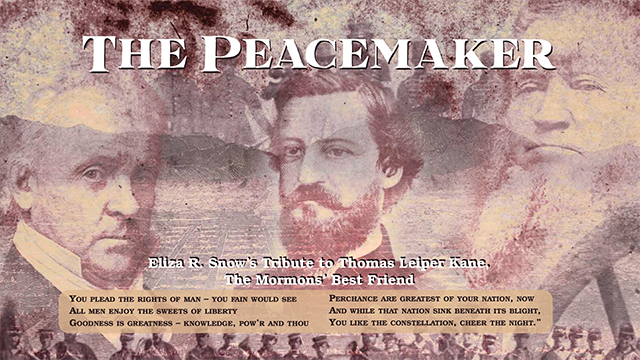
Imagine the feelings that Mormon settlers in Utah had once they learned that an army was marching on them, especially if they had experienced the persecutions in Illinois, Missouri and Ohio. Now the Mormons were almost all alone, except for two allies who had known the Saints for years: Texas Senator and former president of the Lone Star republic, Sam Houston, and a young romantic idealist, Thomas L. Kane.
The Kanes were Pennsylvanians. Thomas’ father, Judge John Kane was acquainted with President Buchanan, who was also from Pennsylvania. Thomas Kane first met the Latter-say Saints in 1846 when he visited them in their camps along the Missouri. When he learned of the invasion, Thoma was determined to do something, anything, to help his Mormon friends who had befriended him When Thomas had become terribly ill, they had saved his life, nursing him back to health.
So, despite opposition from his family and friends, Kane left in early in January 1858 to mediate the peace between Johnston’s Army and the Mormons, carrying a letter from President Buchanan. Seething with anger and resentment, Johnston’s Army could not wait to exact vengeance on the Mormons, but by early March, Kane had completed his 6,000-mile journey with orders from Buchanan for the Army to stand down, In June, the Army marched through the city, but kept on marching 40 miles southwest to a post in Cedar Valley. The heroic journey of the 5’3” 100-pound Kane is the stuff legends are made of and statues erected — the story in the book is told from the viewpoint of people who lived through the ordeal., including Thomas and his wife and family. Today, Kane County Utah bears his name, but his larger-than-life story is still unknown to most people, even Utahns. Kane’s heroic venture on behalf of the suffering Saints are brought back to life in this Marching on Zion.
After his successful mediation of the war and his return to the East, editor and publisher Horace Greeley praised Kane for his efforts in this June 1858 statement in the New York Tribune:
The Government having disavowed all connection with Col. Kane’s efforts, the credit and making of the success with which they have been crowned belongs entirely to him. In our judgment they constitute a claim upon the esteem and gratitude of the company which can never be disputed. He has avoided the effusion of blood; he has saved the expenditure of millions; he has substituted peace for war in which glory was impossible. A private citizen, he has done what all the power of the Government could not accomplish. Honor to the patriot and the peacemaker!
Hi, this is a comment.
To get started with moderating, editing, and deleting comments, please visit the Comments screen in the dashboard.
Commenter avatars come from Gravatar.