
After Brigham Young and the other Church leaders learned that President James Buchanan had indeed dispatched about one-third of the U.S. to march on Zion, Brigham put on his territorial governor’s hat. President Polk gave him that title and authority in 1850 and as of July 24th, 1857, he still was the governor. Accordingly, within days of learning Utah was being invaded, he issued the following proclamation:
CITIZENS OF UTAH:
We are invaded by a hostile force, who are evidently assailing us to accomplish our overthrow and destruction.…The issue which has thus been forced upon us compels us to resort to the great first law of self-preservation, and stand in our own defense….Therefore I, Brigham Young, governor…in the Territory of Utah forbid:
First. All armed forces of every description from coming into this Territory…
Second. That all forces in said Territory hold themselves in readiness to march at a moment’s notice to repel any and all such invasion.
Third. Martial law is hereby declared to exist…and no person shall be allowed to pass or repass into or through or from the Territory without a permit from the proper officer.
Shortly after that, General Daniel Wells gave this order to the Territorial militia to act in defense of their rights and liberties:
“On ascertaining the locality or route of the troops, proceed at once to annoy them in every possible way. Use every exertion to stampede their animals, and set fire to their trains. Burn the whole country before them and on their flanks. Keep them from sleeping by night surprises. Blockade the road by falling trees, or destroying the fords when you can. Watch for opportunities to set fire to the grass on their windward, so as, if possible, to envelop their trains. Leave no grass before them that can be burned… Take no life, but destroy their trains, and stampede or drive away their animals at every opportunity.”
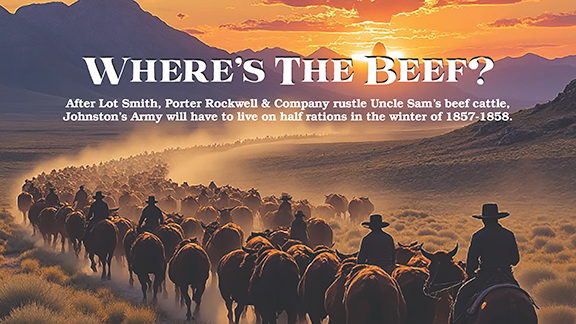
Over the next couple of months, Mormon cavalry men under the command of Lot Smith, Porter Rockwell and others began implementing those orders, burning wagons, taking supplies and stock, including cattle, horses and mules. And, those were the lucky animals — hundreds of them who remained with the Utah Expedition under the command of Col. Albert Sydney Johnston starved to death that winter after grazing areas were burned and supplies were stolen. It was a grim winter for the officers, enlisted men and the bullwhackers who remained in the camps surrounding Fort Bridger.